
I’ve really been struggling lately to come up with a coherent plan for all the steps I need to build (and have already built) that will be displayed on the front of our house. As you know, I built our front porch steps a few years ago, and I constructed them from pressure-treated lumber, PVC boards, and cedar boards.
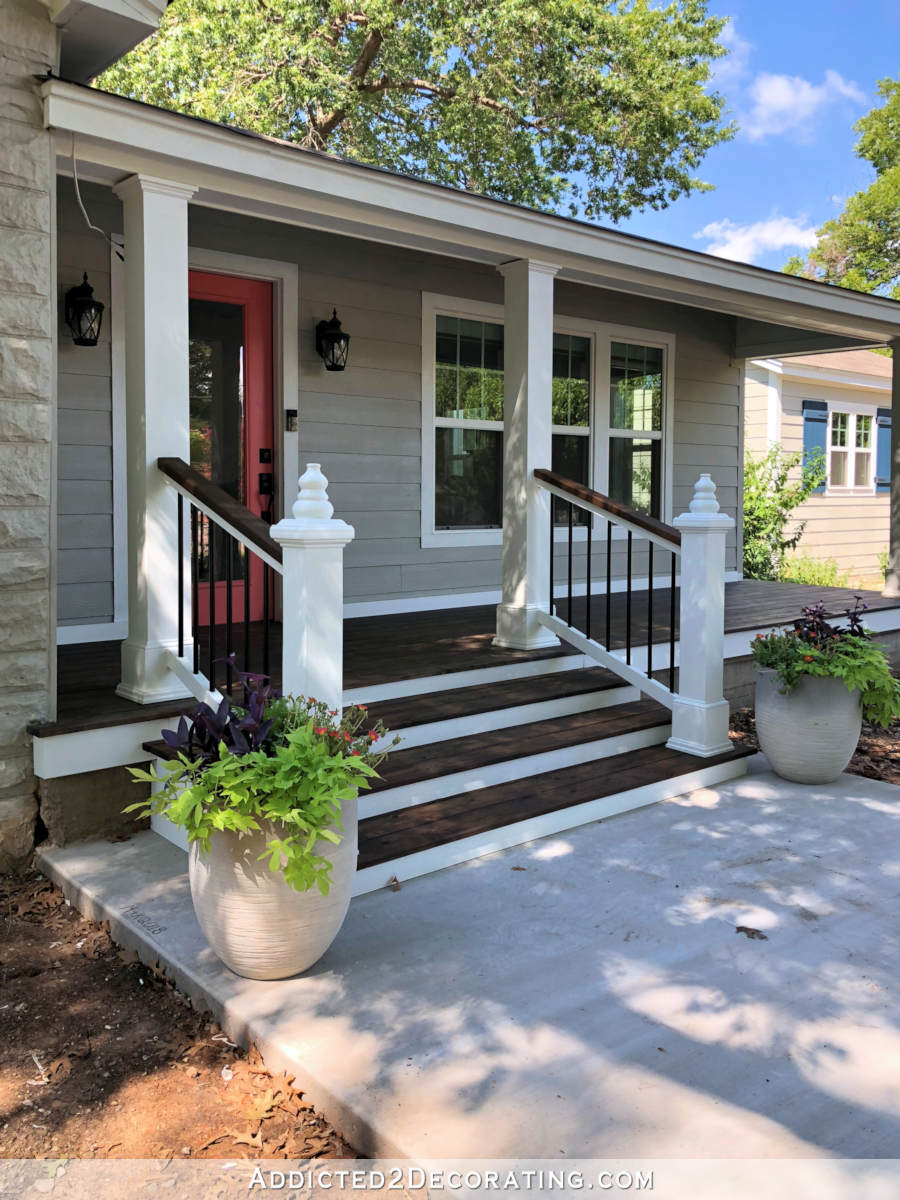
And although the porch, steps, and fascias were finished by then (with some repairs currently in progress), I’ve really had trouble covering the rest of the concrete on the front porch, i.e. the part that would be considered the porch baseboard.
I tried AirStone, which matched the Austin stone already in our house, but never finished it. And because it was there for so long without being sealed, it began to fall apart. Then just a few days ago I tried to cover it with PVC boards, but I had problems with that too. And then I got the idea to cover it with a mortar mix and make my own faux stone or brick look with the mortar mix.
But before I launched into that project, I spent some time trying to imagine how the front porch with the stone or brick baseboard would relate to the steps I still need to build for the side door to my study and the new door to our bedroom, since all three areas are visible from the front of our house. Everyone needs to coordinate in some way.
Until two days ago, my plan was to build wood steps in those other two areas that match the steps leading to our front porch: white PVC board risers with stained wood boards. But as I said, that plan raised other questions. Right now, the front porch is cedar. It is real wood that must be sealed periodically. So if I chose the same design for the other two areas, my options were (1) continue using cedar boards for the porch which will require regular sealing, or (2) change course now and use composite porch boards for the two new areas and make a plan to replace the cedar boards on the front porch with composite boards so that all three areas match.
This has been a big struggle for me. I just don’t want two more areas of cedar steps that require regular maintenance, but I also didn’t want to spend time and money replacing the front porch. Not now. And hopefully never again. I really want to spend that time and money on other projects, and quickly re-caulking the front porch every two years or so is quite doable. I just don’t want more in two other areas.
So I’ve been racking my brain trying to come up with another plan for the other two areas that will coordinate with the front porch without having to look like the front porch. That’s why I spend so much time every night on YouTube trying to find some inspiration.
And two days ago I came across exactly that. I found this channel called Michael Builds and watched some of his videos simply because he is so entertaining and so talented. And while I was flipping through his videos, this one caught my attention in which he builds “quick and easy concrete steps.”

From the beginning, I loved how those steps looked. And concrete steps would be much better and more durable than wooden ones. So I watched that video about three times over the last two days and decided that’s exactly what I want for the other two areas.
But of course there is a major problem. In fact, he builds molds himself and pours the steps, and when they are dry, he takes them out of the molds and places them in place. It’s a big project for a strong man. I, however, am not a strong man who can take big concrete steps on my own. Also, my steps must be much larger (wider and much deeper) than the ones he poured.
I spent quite a bit of time trying to decide if I wanted to take on the task of pouring my own very large concrete steps and wondering if I could gather enough strong men to put my steps in place. But then I wondered if, instead of pouring solid concrete steps, I could use concrete pavers. I can’t lift a solid concrete step on my own, but I can certainly work with concrete pavers.
So after doing a lot of math, calculating, and sketching out my idea, I headed to Home Depot to see what they had. For the side door of my studio, I want three steps from the driveway to the door and I want the top step to have a 30″ landing. And if I make each step 5.5 inches high, it will be the perfect height. And I found just what I needed.
After spending all that time yesterday calculating, calculating, drawing and shopping, I didn’t really have much time to do any real work before it got too dark to work and too late to make much noise. But I had about an hour and a half to do a preliminary design of my idea and see if it really worked. And I think it will be!
The shape still needs some tweaking because I want the bottom step to stick out enough that it ends right where this concrete pad meets the driveway. But the idea is to place these retaining wall blocks, which are four inches high, in a way where they are straight on the sides but rounded in front. And then I’ll add more retaining wall blocks inside that shape to add the structural support for the steps.
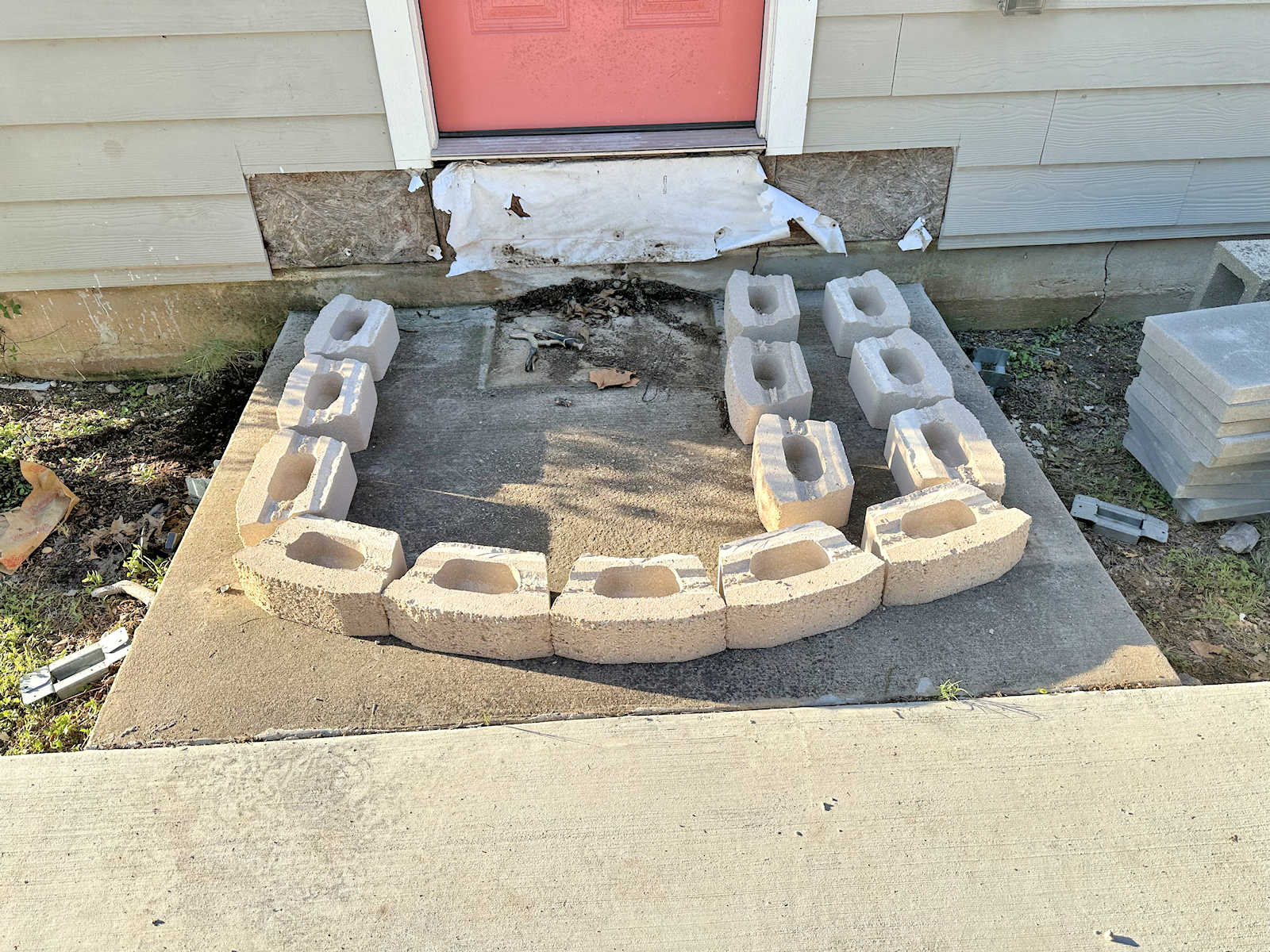
And yes, I still need to decide what I’m going to do with the exposed OSB before I start the official build of these steps. That was eliminated when the siding was installed and when the plan was to build wooden steps to match the front porch steps. That’s where the steps would have joined the house. But now that plans have changed, I need to figure out how to cover that area.
Anyway, to get the corners to meet, I’ll have to cut the two retaining wall blocks in front of each end, and then that side block can fit against it.

And then once that’s done and all the blocks are secured in place with masonry adhesive, I’ll add the pavers to form the step. They look uneven in the photo below because the retaining wall blocks have an edge that needs to be cut before the pavers can sit flat, and I didn’t have enough time to cut them all before it got too dark and too late to work.

But hopefully, you can see the vision here. Remember, those two corner blocks will join together once you cut them to fit against each other. That nasty gap won’t be there.

And once I have all the interior support blocks in place (with that cut edge that keeps the pavers from lying flat right now), I’ll cover everything with the pavers.

And then I’ll go back in with my hand grinder with a masonry wheel and cut the curve in the front.

That’s the plan for this door, as well as our new bedroom door. These steps and the bedroom door steps will match. And then it’s just a matter of coordinating these steps with the front porch. I’m still trying to figure out exactly how to do this (I’m thinking about a couple of options), but the ultimate goal will be to have the stone facade plinth match the look of the retaining wall block risers on these steps. That will unite the three areas so that they are all coordinated. They won’t match, but I’m okay with that as long as they all coordinate and seem cohesive. And really, I love the idea of the front porch being the only area that has stained wood boards because that will not only prevent you from having more wood that needs regular maintenance in these other two areas, but it also keeps the front porch as the main focus of the front of our house.
I’m really, really excited to finally have a plan. I think it will be very nice once all these areas are finished. And maybe I’m too confident and optimistic, but I really believe that these steps won’t be that difficult to complete. I think it will be much easier than building wooden steps! The hardest part will be getting the initial shape of the bottom step perfect. Once this is done, I think the other two steps will be done very quickly.

Addicted 2 Decorating is where I share my DIY and decorating journey as I remodel and decorate the 1948 upper that my husband Matt and I purchased in 2013. Matt has MS and can’t do physical work, so I do most of the house work myself. You can learn more about me here.


