
Over the weekend, I continued with my outdoor projects, focusing primarily on finishing the steps outside the side door of my studio. I finished building these steps (for the most part) last week. I made the steps from retaining wall blocks, which were used as risers, and concrete pavers, which were used as treads.
At that time, the steps looked like this…
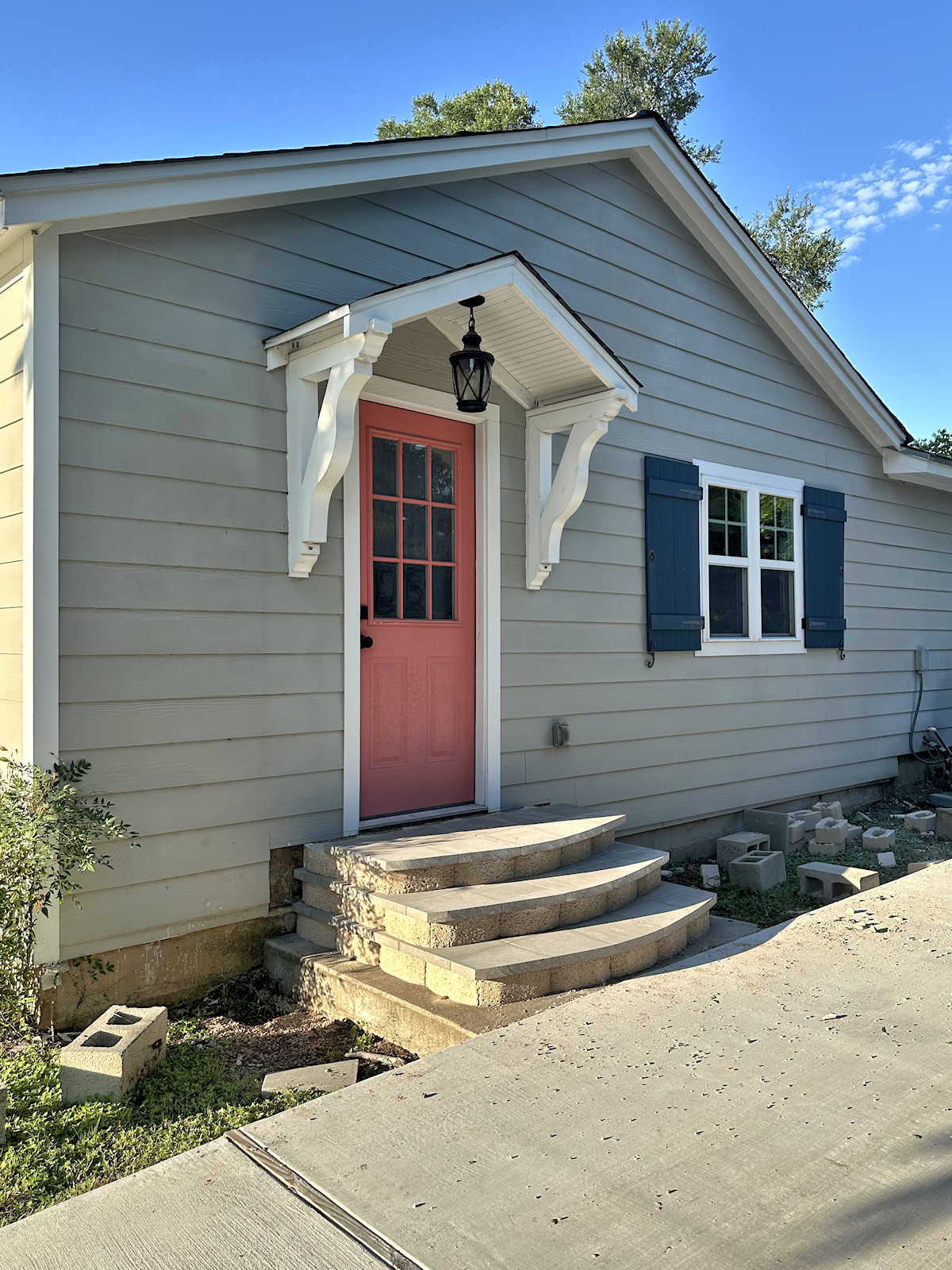
I was happy with the overall look, but they weren’t finished yet. First, I had to figure out how to deal with this last row of pavers on the top step. My calculations didn’t come out perfectly (surprising, I know! ), so these pavers were about 3/8″ higher than the door threshold. Obviously, that wouldn’t work because it would be a tripping hazard for anyone walking out that door.

My second problem with the steps is that the colors were not correct. Since I needed to use locally available materials with very specific heights and thicknesses to achieve the perfect (or almost correct, as the case was the case) final step height, my color choice for the retaining wall blocks was very limited. But I wasn’t discouraged because I paint anything, including retaining wall blocks.
So while I was trying to solve the problem with the last row of pavers, I went ahead and painted the risers. For these, I used the same paint and color I used on our house: Sherwin Williams Duration Exterior Paint with a Satin Sheen in the color Mindful Gray. Since half the front of our house is stone, and this paint has held up surprisingly well on that stone over the years, I was sure it would work well on these retaining wall blocks as well. You can see the risers painted gray compared to the original color here…

I used an old paint brush to apply the paint because I knew these retaining wall blocks were so rough that they would destroy a good paint brush. And when I first applied the paint, it sat on top and looked a little weird, but as it dried, it soaked into the rough surface and dried looking much more natural. In other words, it didn’t have that plasticky look that latex paint usually gives a painted surface. Maybe you can see what I’m talking about in the photo below. When I took this photo, I had just finished painting the block on the side of the middle row in front of the steps (i.e. furthest from the house). You can see how the wet paint looks more like it’s on top of the stone, but if you compare it to the row above, you can see how it absorbs as it dries, giving it a more natural look.

When I finished painting the risers, I knew how I wanted to solve the problem of the last row of pavers. I started by cutting them all to fit the space, using a combination of my wet tile saw and my hand grinder with a concrete cutting wheel to get the pavers to fit around the siding, trim, and door sill. But to eliminate the trip hazard, I used a concrete grinding wheel on my hand grinder to round the edge. You’ll also see that I left about a 1/4″ gap between the pavers and the edge of the door sill. While I caulked the cracks where the pavers met the siding and trim, I left this space open where the pavers met the threshold.

This is the abrasive disc I used to create that curvature in the pavers, and it allowed me to shape them very quickly. I bought this at Home Depot.

So, here is my thought process on why I left that 1/4″ space open between the last row of pavers and the door threshold. When it rains (and it rains a lot here in Central Texas), I expect the rain to fall from the steps that are away from the house, since the steps are set on a concrete pad that is a little higher on the side of the house and a little lower on the side of the driveway. But since the top step is a little higher than the threshold, water would be trapped there if you sealed that gap, and depending on how heavy the rain was, there would be a risk of water filling that threshold. But with that space there, water can escape, seep through the gravel and spaces between the pavers, and come out the bottom of the steps, since none of that will be sealed to be watertight. We’ll see if it works the next time it rains a lot, but it makes sense in my opinion that everything will be fine.
Because I want water to be able to escape instead of being trapped inside the steps, I did not caulk or seal any of the pavers inside the structure. But I caulk the cracks between the pavers anywhere on the steps that show. For this, I used my usual latex putty, DAP Alex Fast Dry, and wiped off all the excess with a damp cloth. This process was somewhat like grouting tile, but with caulk instead of grout.

Again, I only caulked the pavers that you see on the finished steps, and I didn’t caulk the cracks between the blocks that I used for the risers because I want water to be able to escape instead of being trapped inside when it rains.

Once the pavers were caulked and dry, I primed the steps with my favorite primer: Zinsser shellac-based primer. And I only used a brush to apply the primer to make sure the primer reached all the rough areas.

I agonized over the decision of what products to use to paint these pavers. I made three separate trips to Home Depot to purchase products and two trips to return them before making my final decision. I’ll tell you all about that once I have the steps painted and I’ll tell you why I landed on the products I finally decided on. But for now, this is progress. I only have one more step left in this whole process before these are finalized finalized. And although the final steps will not be white, I must admit that I like white. When I prepared them all and stood back to look at them, I wondered if I should have chosen white as the final color. But I think it would be a nightmare to keep the white steps clean, so I’ll go ahead with my paint color decision.
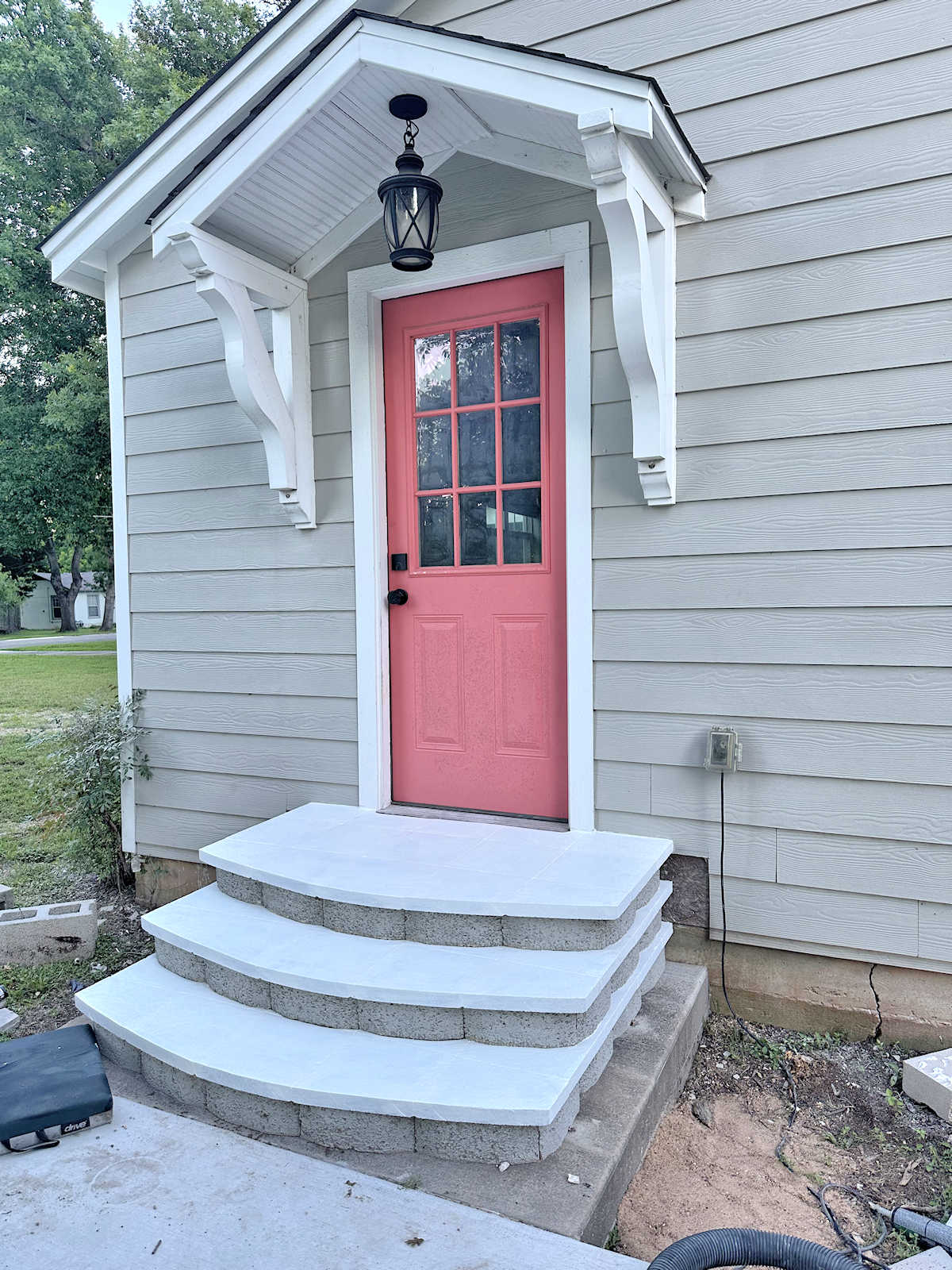
But like I said, I’ll share with you the products (and color) I finally decided on when I painted and finished these steps, and I’ll tell you why I ended up choosing these products over the others (i.e. the ones I made two trips to Home Depot to return). But finally, here’s a look at the top step with the rounded edge of my studio entrance.

Hopefully I can paint these steps today so I can show you the fully finished steps tomorrow.
More about the exterior and patio of our house
see all exterior &
DIY garden projects

read everything outside and
garden blog posts

Addicted 2 Decorating is where I share my DIY and decorating journey as I remodel and decorate the 1948 upper that my husband Matt and I purchased in 2013. Matt has MS and can’t do physical work, so I do most of the house work myself. You can learn more about me here.


