
I had to miss you yesterday morning because I was meeting with the plumber. He arrived earlier than expected and while he was here I got his feedback on other things as well. My kitchen sink is not fixed yet, but he will be back today to do all the work.
I actually learned a lot from him yesterday, so while this isn’t as exciting as a room makeover or my painted entryway console (which I’ll share tomorrow), I wanted to pass on all the great information he shared with me yesterday because I think many of you might find it helpful.
First, following your advice, I decided to go with a new garbage disposal. As several of you have said, the single bowl sink is not the problem. The problem was the garbage disposal and the pipes under the sink. In the past, I have always opted for one of the cheaper Insinkerator garbage disposals available at Home Depot. It’s the one called the Badger 500 and it’s a 1/2 horsepower garbage disposal. He said the two problems with lower-end Insinkerator garbage disposals are (1) lower power and (2) the material the internal components are made of.
He always recommends a 3/4 horsepower garbage disposal, but more importantly, he always recommends one with stainless steel grinding components. To be honest, I had never paid attention to this. I had no idea what made some Insinkerators cost $149 and others $269 or more. Since I’m cheap, I always bought the low-end ones without comparing them to see what makes them different. I always assumed it was just the horsepower that made the price difference.
So this time I read the boxes to compare the differences. I noticed that the Badger 500 I usually buy not only has galvanized steel grinding components, but it also has something called a single stage grind. Others had two-stage grinding and others had three-stage grinding. I had never noticed this before and didn’t even know what it meant. I mean, I could probably assume what it means. Obviously, the more grinding stages, the better. But I still checked ChatGPT when I got home to understand it better. This is what it said:
He “routine stages” in a garbage disposal see how many times food waste is processed before it leaves the disposal and goes down the drain. More stages mean that the waste is break down into progressively smaller particleswhich helps prevent clogs and can handle tougher food scraps.
Therefore, a single-stage garbage disposal is intended only for soft foods (like vegetables and small scraps). But you may have problems with fibrous foods, bones, and large amounts of food. And I’ll be honest. In the past, I didn’t pay much attention to what I put in the garbage disposal. If it’s food, I’d put it in the garbage disposal. That’s probably why I burn through cheap garbage disposals much faster than I should.
A three-stage grind breaks food down into much smaller particles before sending them into pipes. It’s like running food through a blender until it’s almost liquid. And a three-stage garbage disposal can process bones, fibrous foods and peels. I am not suggesting that we ought You’re pouring that stuff down the drain, but if some of it escapes and goes down the drain, a garbage disposal with a three-stage disposer can take care of it. And because they pulverize food to a near-liquid state, they are safe for homes with old pipes, homes with septic systems, and homes that have long runs of sewer pipe under the house.
So this time, I made sure to buy one with 3/4 horsepower, stainless steel grinding components, and three-stage grinding. I ended up choosing this Insinkerator 45SS from Lowe’s. It was about $120 more than the Badger 500 I normally buy, but if this one lasts much longer than the budget one, the higher price will be worth it.
While here, I also asked the plumber what is the best way to clean a garbage disposal and keep the pipes under the sink clean. Because I am easily influenced by specific influencers, I purchased this debris cleaner on Amazon (affiliate link).

I asked him if products like this really work. He said…No. Well, that’s not entirely true. He said they are actually good for deodorizing and keeping you smelling fresh. But beyond that, claims of deep cleaning, protection, and anything like that are overblown.
So I asked him what he recommends for cleaning and keeping pipes as clean as possible. His answer was ice and Dawn dishwashing liquid. He said to fill the garbage disposal with as much ice as I could, add Dawn dishwashing liquid, and then turn it on. The ice will break up and act as an abrasive, and then Dawn dishwashing liquid will clean away the grease and grime. And although he didn’t say it (and I didn’t ask), it would make sense to me that you’d want to run the hot water for a while after that, since Dawn dishwashing liquid works best with very hot water. Therefore, you don’t need fancy cleaners that claim to keep your garbage disposal and pipes clean. Just ice and dawn. He said it’s okay to stick with the Disposal Cleaner tablets because they smell good and will keep you smelling fresh. Just don’t trust them to do the deep cleaning.
Anyway, that’s all I learned about garbage disposals. It was very educational. And while I won’t be relying on my garbage disposal as much as I have in the past (I’m going to try to be much more conscious about what I put down the drain), I decided to go ahead and buy a new one because food inevitably goes down the drain, even when I’m not intentionally scraping dishes with food scraps in the sink. And it’s much more convenient to flip the switch and send it down the drain rather than having to clean a strainer ten times while you wash dishes just to keep water draining from the sink.
While he was here, I also asked him about tankless water heaters. My next big project will still be converting the guest bathroom into a storage room, and I would love to put a tankless water heater on the wall right in front of the doors so I can have a full wall of cabinets on the left and a full wall of storage area for Matt’s gear on the right.
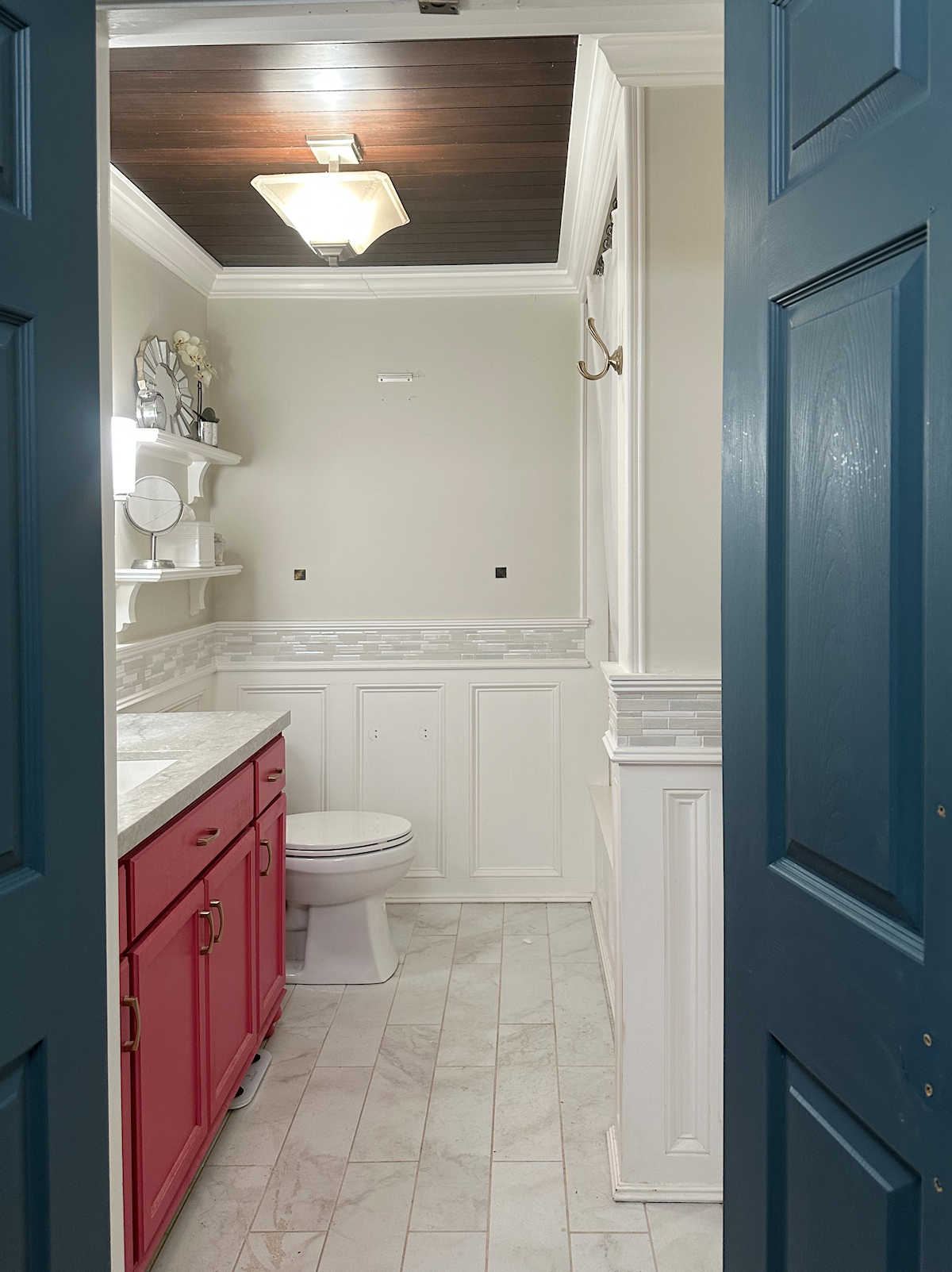
But in trying to figure out what type of water heater I want, I haven’t been able to determine whether or not I can put a gas tankless water heater on an interior wall. I received your feedback while you were here and you assured me that I can have a gas tankless water heater on an interior wall. There are some caveats. It has to be one that is closed, but that doesn’t mean you have to build an enclosure around it. I just have to buy one that is attached. I’m not exactly sure what that means yet, but I’ll trust him to guide me in purchasing the right one.
I’ve been waiting to start that project because I haven’t felt inspired to start. I’ve been focusing on other fun, random projects while I wait for inspiration to strike. And I think part of my lack of inspiration has been my confusion over the water heater decision. I really wanted tankless gas, but from what I was reading, it didn’t look like I could do that on an interior wall. So I wasn’t sure which direction to take, and because I was confused, I felt uninspired.
But after he left yesterday, I finally started to feel the inspiration and excitement for the next big project. So I’m almost there (mentally speaking). I’m almost to the point where starting that project doesn’t seem horrible and overwhelming and laborious, but it feels exciting and fun. I’m not 100% there, but I’m getting there. I still want to finish the front porch baseboard and then finish a couple more outdoor projects before I get started. But once I’m done, I know I’ll be ready to get in and start tearing down that bathroom. And I’ll be excited about it!
Anyway, I’ll be back tomorrow to show you the painted entry console. It looks so good! Painting it was definitely the right decision (for me).
Addicted 2 Decorating is where I share my DIY and decorating journey as I remodel and decorate the 1948 upper that my husband Matt and I purchased in 2013. Matt has MS and can’t do physical work, so I do most of the house work myself. You can learn more about me here.


